Some of you may have seen us at the October ConSoc Plant Stall at Blackheath Markets, arresting the queued plant buyers with a question, “How many balls do you think we have collected?”
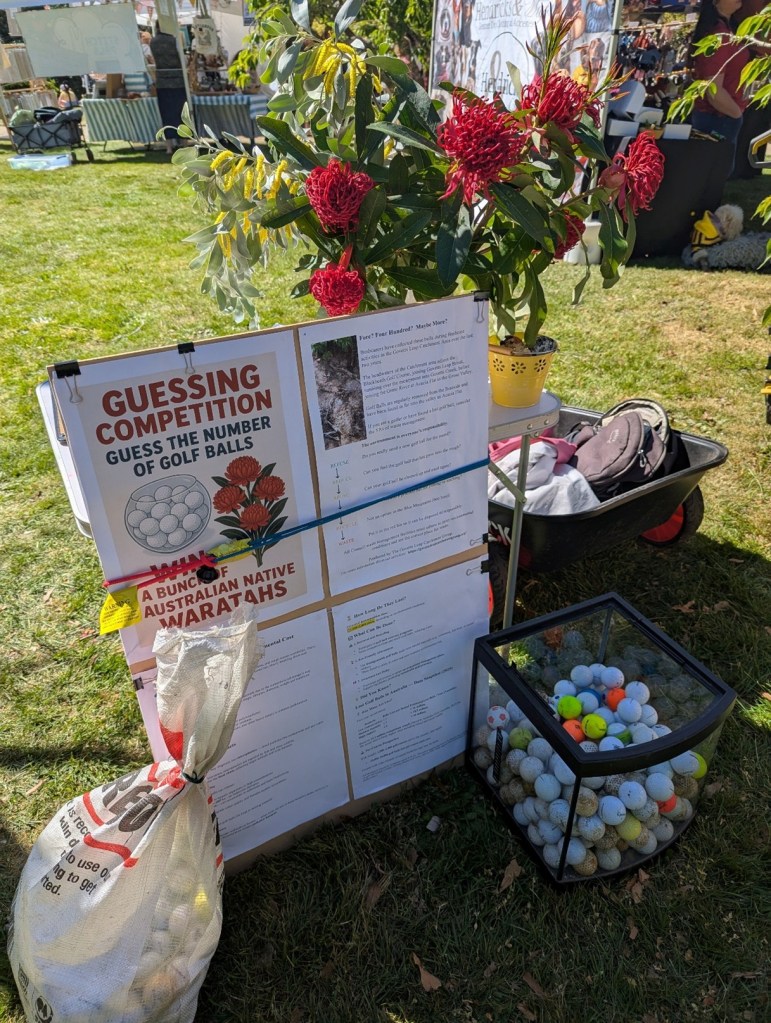
So, who are we? And why did the ConSoc Nursery Manager let us harass the customers?
We are the Govetts Leap Catchment Group, a group of locals working in bush regeneration across the Govetts Leap Catchment. While searching for weeds, we regularly find golf balls and, if we have space in our weed bags, remove them. During one of our cake-inspired lengthy breaks, it became apparent that not only had many of us collected them, but we also had lots of them stored in our
homes, not knowing what to do with them. I had tried Blackheath Gifters on Facebook and the Golf Club, but neither was interested. We figured we had hundreds between us, and if we stumbled on this many, perhaps it was a bigger problem that people should know more about.
So, I did some homework. Here are five facts that surprised me.
- There are no rules as to what a golf ball should be made from. Modern golf balls are made from: Synthetic rubber or plastic (often polybutadiene), thermoplastic resin (Surlyn) or urethane and additives such as : Zinc oxide, titanium dioxide, and other heavy metals to enhance performance. These materials are not biodegradable.
- Microplastic Pollution: As golf balls degrade, they fragment into microplastics — small particles that contaminate soil and water.
- Chemical Leaching: Decomposing golf balls can release Zinc – toxic to aquatic organisms in high concentrations, Bisphenol A (BPA) – an endocrine disruptor and heavy metals – can accumulate in sediments and harm biodiversity.
- Wildlife Hazards: Animals may mistake golf balls for food or nesting material. Golf courses often border wetlands or forests — when balls are lost in these sensitive areas, retrieval is difficult. Over time, accumulation creates pollution hotspots, and impacts ecosystems.
- The estimated decomposition time of a golf ball is 100–1,000 years, depending on environmental conditions.
The golf balls we removed were found in locations adjoining Blackheath Golf Course, the Braeside Walking Trail area, Govetts Leap Brook, and as far down Govetts Creek as Acacia Flat in the Grose Valley. This reflects the journey of water from the golf course through the catchment and demonstrates the far-reaching impacts of human activities on the plateau.
And if this is what is happening in Blackheath, how big a problem is this? The only research I could find was US data from 2009, which suggested that lost golf balls generated 20,000 tons of plastic waste annually. An extrapolation of data on the average number of lost golf balls per round and the number of registered golf rounds played in Australia in 2023-24 (Golf Australia) resulted in 18.5 million golf balls lost in Australia annually, and that’s without counting unregistered rounds!
So, what can be done?
Golf balls are just another example of waste, and the Rs of waste management are key. So, if you are a golfer, this is how they would apply:
| REFUSE | Do you really need a new golf ball for the round? |
| REDUCE | Can you find the golf ball that has gone into the Rough? |
| REUSE | Can your golf ball be cleaned up and used again? |
| REPURPOSE | Can it be used as a practice ball for putting or teaching? |
| RECYCLE | Not an option in the Blue Mountains (boo hoo)! |
| WASTE | Put it in the red bin so it can be disposed of responsibly. |
And if you’re not a golfer and you see a golf ball somewhere it shouldn’t be, pick it up and throw it in the red bin.
Just how many golf balls were there?
We had 64 guesses, ranging from 142- 1500, heard stories about golf and lost golf balls, including some experts who examined the balls and said some were well over fifty years old (as UK and US balls were different sizes back then – who knew?), and some had a cost price over $15 individually.
The winner was a traveller who guessed 384. The correct number of balls was 380. He was delighted to receive the waratahs, which were to be given pride of place in the caravan on a return trip to Queensland.
Thanks to Bronwyn and all the ConSoc Nursery Team for allowing us to share your space.
Tracie McMahon
 Govetts Leap Catchment Group