I recently had the opportunity to join Alice and Will from the BMCC Healthy Waters Team at their annual water quality sampling of Govetts Leap Brook.
This is one of over 70 sites across the Blue Mountains which the Healthy Waters staff sample annually. This provides the data for their annual Waterways Health Snapshot which is distributed to residents. Since the 2019 fires the water quality has been Fair, having been Good prior to that. We hoped for a better result this time. This program has now been operating for 25 years and provides a unique dataset for study.
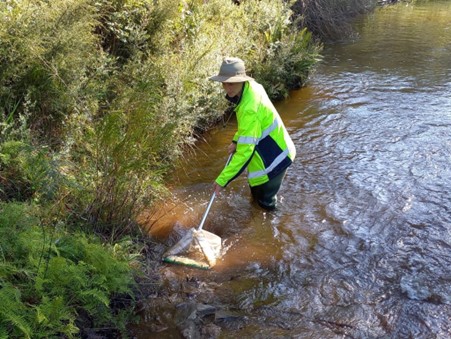
To begin, we based ourselves at the crossing near the start of the Braeside Track. While Will instructed me in collecting a simple water sample, Alice collected a water bug sample along the brook. This is done using a fine mesh net along the 10m of the edges of the brook over a 100m section.
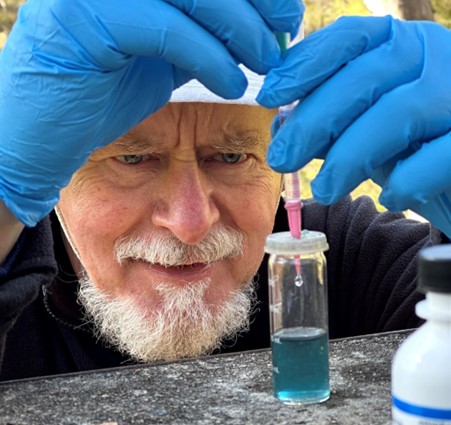
We then collected some water chemistry data. The first step was to get an alkalinity reading by dropping acid into a dyed water sample until it changed colour. Will instructed me in how to do this.
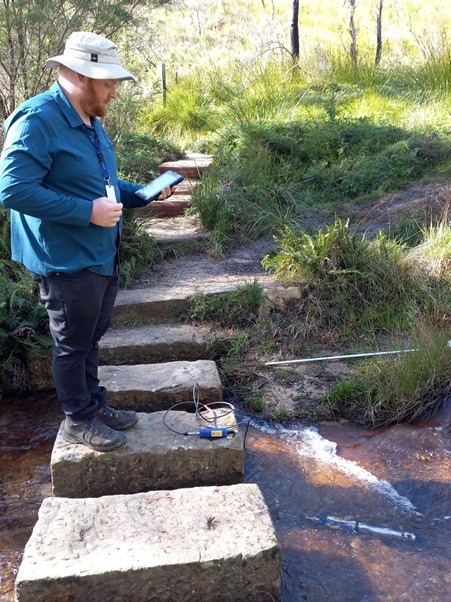
He then put the Council’s hi-tech testing device into the water which over a few minutes collected about 20 different readings onto a dedicated tablet. These are transferred to Council’s data base back in the office. Will highlighted the PH, electrical conductivity and dissolved oxygen readings as being of particular interest. Tests for faecal coliforms, nitrogen and phosphorous are done back in the lab.
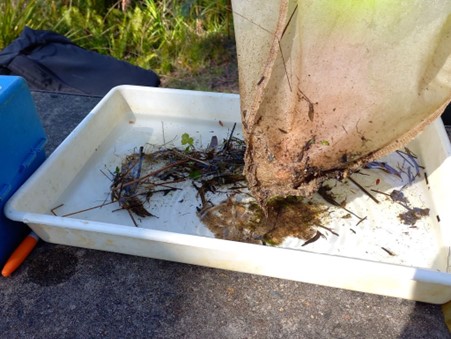
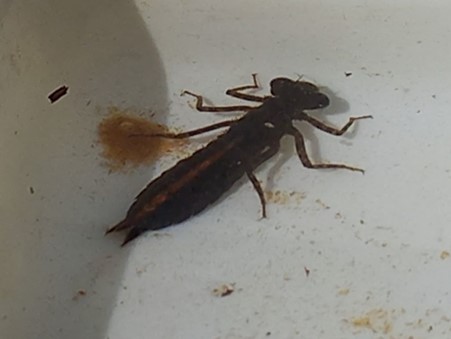
We then got on to the most time consuming event of the morning, counting water bugs over 2 periods of 20 minutes in the sample Alice had collected earlier. The net was emptied into 2 water filled trays. Initially there didn’t seem to be much movement but soon a 2cm Dragonfly nymph appeared and gradually more and more bugs could be seen – maybe they were coming out of hiding or I was getting more used to what to look for.
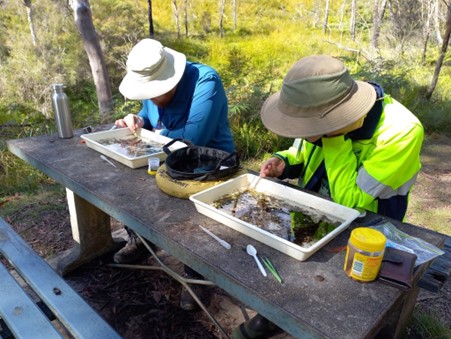
Alice and Will collected all of these (with just a little help from me) and noted numbers of bugs by family. A couple of each family and all the Chironomidae were put in alcohol for more analysis at the lab and the rest returned to a water bucket and back to the brook.
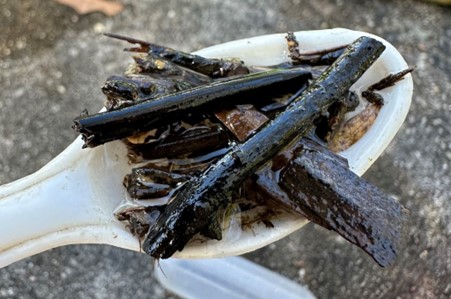
Of particular interest to me were a type of caddisfly (Leptocerids) which live in the ends of ‘tubes’. Some use grass stalks and others build their own from vegetation fragments. There were lots of these and Will collected a personal best of 35 in one teaspoon from his tray. They were in fact the most abundant family in the sample.
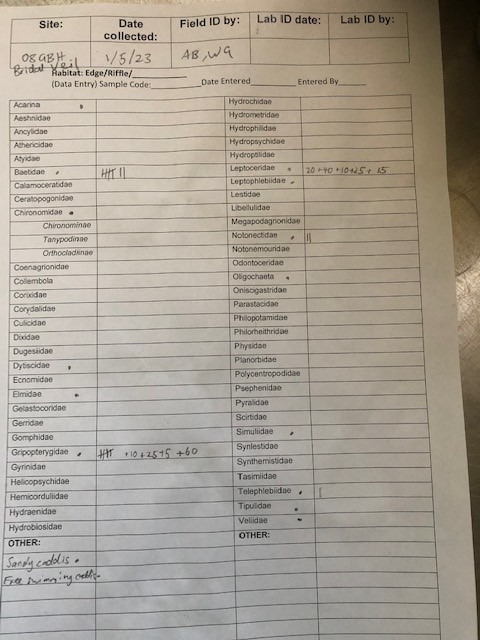
There are a number of families which are ‘particularly’ sensitive to water quality called the EPT families. Of these we got two in high numbers, and we also recorded some sensitive families that hadn’t been present in samples since before the 2019 fires.
Overall the preliminary results were promising and it is highly likely that Govetts Leap Brook will again be classified as Good or better this year.
Many thanks to Alice and Will for providing me with a much better understanding of how water quality surveys are carried out.
Keith Brister, May 2023
Photos by the author except as noted.
 Govetts Leap Catchment Group